The HFEA's monthly newsletter for clinic staff |
| |
|
Revised and new consent forms and guidance to consent update |
Clinics are reminded that 14 updated consent forms and one new consent form, published on 19 December 2023, will come into force on 19 February 2024. You must use the new and updated forms in clinic practice from 19 February 2024 – and not before.
In this December 2023 Chair’s Letter, we released updated versions of the following 14 consent forms: MT, WT, WPT, GS, MGI, WGI, RE, RG, RE(TP), RG(TP), WSG, MSG, MMT and WMT. These updates follow changes to the Code of Practice 9th edition (9.4) and allow patients to consent to the continued storage of their eggs, sperm and embryos, without consenting to the use of their material in treatment whilst they are mentally incapacitated. We have also created a new form, the MIT, to allow patients to consent to their eggs, sperm or embryos being used in training in the event they lose mental capacity if they would like to do so.
This means that the MIT does not need to be completed by every patient and only those patients who wish to consent to this option need to complete the form.
In light of this new form, we have also updated General Direction 0007 to include the MIT. This updated General Direction 0007 is available now for information purposes and it will come into force on 19 February.
The new and updated forms come into force on 19 February 2024. On this date, the Consent Forms page of Clinic Portal will be updated.
To support these updates, on 5 February 2024, we will publish updated versions of ‘Consent forms: a guide for clinic staff’ and ‘How to use HFEA consent forms and statutory notices – for clinic staff’. Together these documents provide guidance on how each consent form should be completed and in what circumstances each consent form and Statutory Notice will apply.
As these documents contain guidance on the new and updated forms, you should not use them in clinic practice until 19 February 2024. Both documents will be published on the Consent Forms page of the Clinic Portal. |
Field Safety Notices (FSNs) |
FSNs are issued by manufacturers to notify users of an issue or potential issue regarding the safety of a medical device, or any other product which falls under the Medical Device Regulations. These products may be IVD’s (Invitro Diagnostic), reagents such as culture media, products or parts that may form part of the Medical Device. FSNs also include actions that need to be taken, referred to as ‘field safety corrective actions’ (FSCAs).
If you receive a FSN from a manufacturer you must always act on it and follow the advice given. The MHRA publish all FSNs on their website and the HFEA issue an alert (via email to PRs) when required to ensure that centres affected have received the FSN.
It is important to ensure that your centre has a documented procedure to follow upon receipt of a FSN and that all staff are aware of it. It is also important to notify the HFEA if any patients, gametes or embryos may have been impacted. This must be reported as an incident via the incident reporting system.
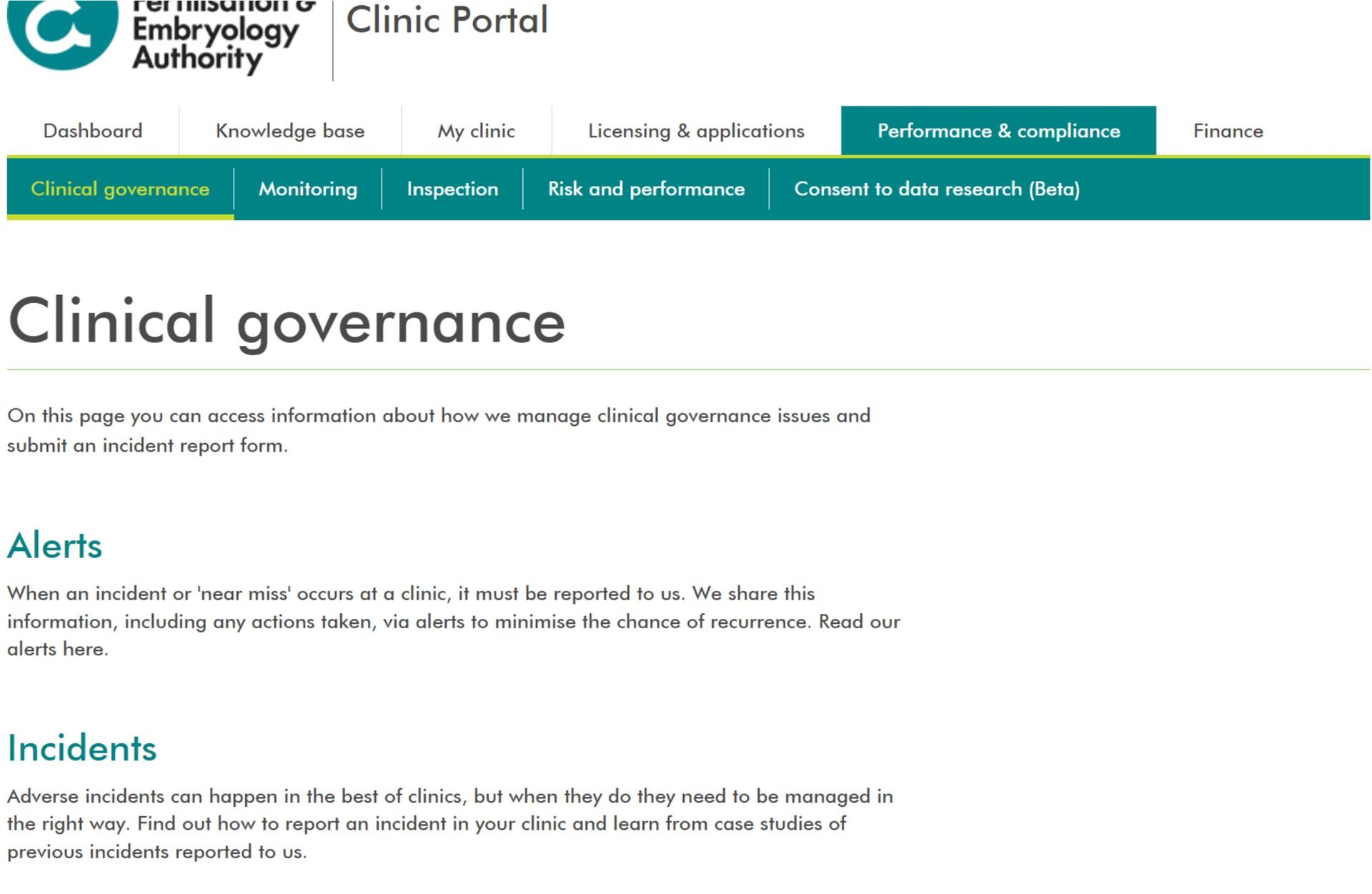
Alerts issued can also be viewed in the password protected area of the Clinic Portal under 'Performance & compliance'. |
Future of support services for donors and donor-conceived people |
The HFEA has funded support services for donor conceived people accessing information, and donors considering removing their anonymity or whose identifying details have been requested, since 2015. The current arrangements for funding support services (which we have no statutory duty to provide) from within the HFEA’s budget are not sustainable, therefore a review was necessary. At the January meeting the Authority decided to end funding, effective September 2024. We fully understand the importance of support, and this decision was not taken lightly.
Over the last year we have engaged both directly, and with organisations representing, donor-conceived people and their families to understand their views, needs, and any concerns. This included a survey of people impacted by donation and stakeholder roundtables with organisations representing affected groups. Other work undertaken by the HFEA to explore options for the future of support services also included data analysis, policy research, and review of academic literature.
We now plan to work closely with organisations supporting donor conceived people to improve and expand the information and signposting available through our website. We will ensure high-quality information is available on our website and will continue to signpost to support providers. Once this new information is available, we will update you, and encourage clinics to signpost to the new resources.
In the meantime, we’d also like clinics to review any information they currently provide to donors and patients, to ensure that they are aware of the changes. You can direct patients to our website as this contains useful reading for donors and donor-conceived people around preparing to access information, and preparing for possible contact – it also provides links to partner organisations where people impacted by donation can access support.
|
IUI annual data submission |
All licensed centres undertaking Intra Uterine Insemination (IUI) or Gamete Intra-Fallopian Transfer (GIFT) with partner sperm must submit an annual return to the Authority no later than 28 February in each calendar year (as per General Direction 0005).
Annual returns for the year ending 31 December 2023 should therefore be submitted by 28 February 2024.
You must do this through the Clinic Portal using your PR login (they cannot be sent through any other portal login). Previously some centres thought they had submitted their returns, only to find them in the ‘PR drafts’ awaiting final approval and submission, so please ensure you submit your return when logged in as PR. The tab for IUI data submission can be found under Licence & applications > New licences, returns and applications and if you scroll down, you will be able to see IUI submission forms. |
New HFEA dashboard launched |
Our first ever HFEA dashboard is now available on our website. Our dashboard gives users the opportunity to explore HFEA data and find statistics on their own areas of interest and is part of our commitment to improving transparency and accessibility in the data we collect from clinics.
See here for a video to show how to navigate the dashboard. The HFEA dashboard is produced from data collected from licensed fertility clinics in the UK and covers the period from 1991-2021, where data is available. You can find out more and access the dashboard here. |
FAQs for clinics on Releasing Donor Information |
‘Making it real’ workshop – 26 April 2024 |
Donor Conception Network (DCN) are running a ‘Making it real’ workshop for professionals who work in fertility or with donor conception families on 26 April 2024.
This workshop aims to deepen your understanding of the ways in which creating a child using eggs, sperm or embryos from a third party, including with surrogacy, is different from standard fertility treatments. It looks at ways to help prospective parents consider the lifetime implications of this route for the child and the family and how to best provide support at different stages. Details of the event and booking information can be found here. |
|
|
The use of Pre-Exposure Prophylaxis (PrEP) drugs such as Truvada® to prevent HIV is increasing and often these medications can be obtained via a private prescription and/or online pharmacies.
The drugs used in both Pre and Post Exposure Prophylaxis for HIV, known as PrEP and PEP may interfere with routine HIV screening tests, such as those carried out for screening patients and donors prior to treatment or donation.
The use of PrEP may interfere with testing for HIV by delaying seroconversion or by giving unclear results. Post Exposure Prophylaxis (PEP) has a similar mechanism of action to PrEP and may also interfere with testing results. In the UK PEP is prescribed to people who have been exposed to someone who may have HIV, this includes sexual activity or exposure through a needle stick injury. |
|
|
Editorial statement
Clinic Focus is the official electronic newsletter of the Human Fertilisation and Embryology Authority, is produced by the editorial team of the HFEA and provides a monthly roundup of news and information for clinics and their staff working in the field of fertility treatment. No part of this publication may be reproduced without prior permission. You can view our privacy policy on our website. Click here to unsubscribe 2 Redman Place London E20 1JQ © Copyright Human Fertilisation and Embryology Authority, 2019 |
|
|
|